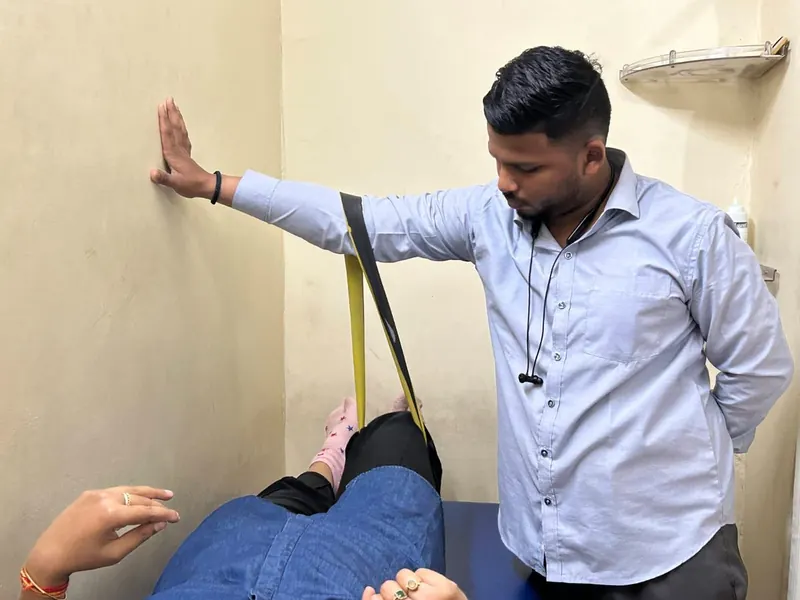
Which Knee Surgeries This Covers
VPARC provides structured post-operative rehabilitation for ACL and PCL reconstruction, meniscus repair or meniscectomy, total knee replacement (TKR), partial/unicompartmental knee replacement, patellar tendon repair, and knee arthroscopy. Each surgery carries its own precautions and milestones, so your programme is built around your specific procedure and your surgeon's protocol — not a generic knee routine.
Phases of Knee Rehabilitation
Protection phase (early days to 2 weeks) — swelling and pain control, gentle range of motion within your surgeon's limits, and early quadriceps activation to prevent muscle shutdown.
Mobility and strengthening phase (2-8 weeks) — progressive range of motion work, closed-chain strengthening, gait retraining, and balance work as weight-bearing status advances.
Functional strengthening phase (2-4 months) — building quadriceps and hamstring strength to match the uninvolved leg, addressing any residual limp, and reintroducing daily activities.
Return-to-function or return-to-sport phase — for younger, active patients (particularly after ACL reconstruction), sport-specific drills, plyometrics, and cutting/pivoting readiness testing before full return.
What We Focus On
- Range of motion restoration — preventing stiffness and achieving full extension and flexion
- Quadriceps and hamstring strengthening — the single biggest predictor of good outcomes after knee surgery
- Gait normalisation — correcting compensatory limping patterns before they become habitual
- Swelling and pain management — manual techniques and modality-based care alongside your exercise programme
- Balance and proprioception — critical for confidence on stairs, uneven ground and return to sport
Who Should Book This
Anyone scheduled for or recovering from knee surgery — whether the goal is walking comfortably again after a replacement, or a full return to competitive sport after ACL reconstruction.
Common Concerns After Knee Surgery
- Swelling and warmth around the knee, which can last for weeks
- Stiffness, especially first thing in the morning
- Difficulty fully straightening or bending the knee
- A weak thigh muscle that feels like it is giving way
- Night pain, and a tender or numb area around the scar
Using Crutches and Walkers Safely
Your physiotherapist will show you how to use crutches or a walker, how to manage steps, how to get in and out of a chair, bed and vehicle, and when you can reduce support. Always follow your surgeon’s weight-bearing instructions.
Report to Your Surgeon If You Notice
- Calf pain, swelling or warmth
- Fever, or redness, heat or discharge from the wound
- A sudden increase in pain or swelling
- Sudden chest pain or breathlessness (this is an emergency)