What is a slip disc?
"Slip disc" is the everyday name for a disc prolapse or herniation. The discs are cushions between the bones of the spine. A disc has a firm outer ring and a softer centre. If the centre pushes against or through the outer ring, it can irritate nearby nerves. In the lower back this commonly causes pain that travels into the buttock and leg (sciatica). In the neck it can cause pain into the shoulder and arm.
Symptoms
- Back or neck pain that may be worse on bending, sitting or coughing
- Pain, burning or electric-shock feeling spreading into the leg or arm
- Numbness or pins and needles in the leg, foot, arm or hand
- Muscle weakness, such as difficulty lifting the foot
- Stiffness and difficulty standing up straight after sitting
Many disc-related problems improve over weeks to months with sensible activity and physiotherapy, though how long it takes differs from person to person.
How VPARC assesses a suspected disc problem
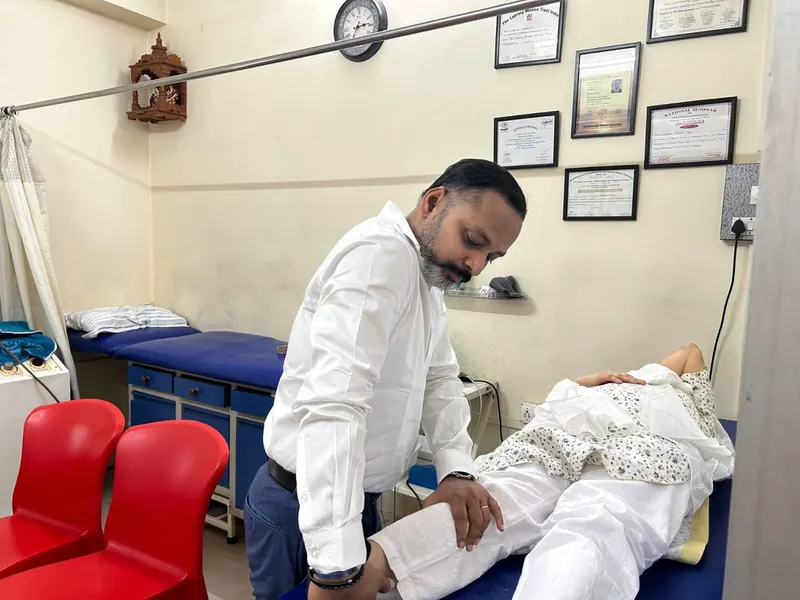
Dr. Prashant Punj takes a detailed history and examines your spine movement, nerve function (sensation, strength and reflexes) and how your symptoms respond to different positions and movements. If you have an MRI, please bring it, but the plan is based mainly on your examination, because scan findings do not always match symptoms.
Treatment
- Movement-based treatment — finding positions and exercises that ease leg or arm symptoms and calm the nerve
- Hands-on therapy — mobilisation and soft tissue work to reduce stiffness and muscle spasm
- Nerve mobilisation — gentle movements to help an irritated nerve move more freely
- Core, hip and back strengthening — built up gradually as pain allows
- Posture, lifting and sleeping advice — so daily habits stop re-irritating the disc
- Traction — in selected cases, as part of the wider plan
- Graded return — to work, driving, sport and household tasks
What you can do at home
- Stay as active as pain allows; short, frequent walks usually help more than bed rest
- Avoid sitting for long periods and avoid heavy lifting and repeated deep forward bending in the early stage
- Sleep on your side with a pillow between the knees, or on your back with a pillow under the knees
- Follow the exercises you are given rather than copying routines from videos
Emergency signs: go to a hospital now
- New difficulty passing urine or controlling bowel movements
- Numbness around the genitals, buttocks or inner thighs (saddle area)
- Rapidly worsening weakness in a leg or foot
- Symptoms in both legs
- Back pain with fever, after significant trauma, or with a history of cancer
Does a slip disc need surgery?
Most people with a disc prolapse are first treated without surgery. Surgery is considered by a spine surgeon when there are emergency signs, progressive weakness, or severe symptoms that do not settle despite proper treatment. If you do have an operation, VPARC provides pre- and post-surgery rehabilitation in coordination with your surgeon.